

How I Help
I help independent professional and B2B services firms see what in their growth model is real, what is fragile, and where it breaks down when they try to compete and grow.
My work typically includes:
showing where commercial performance is stronger on the surface than it is underneath
identifying the few points where better decisions, discipline, or structure would change outcomes most
improving how the firm qualifies, pursues, and converts the right opportunities
helping leadership build a growth model that can hold up under pressure and competition
Start With One Real Pursuit
Most firms try to understand growth through pipeline, activity, or outcomes. But that rarely explains why similar firms win—or lose—the same opportunities.
In complex services, the clearest view of how the revenue engine actually works comes from a single deal—where access was created, the problem was shaped, and the outcome was effectively determined.
Examining one pursuit closely can reveal:
where growth is actually being driven
where outcomes depend on individuals vs. systems
where the model is likely to break as the business scales
I use this as a focused, paid diagnostic to make those patterns visible quickly—before committing to broader change.
→ Learn more about this pursuit diagnostic
Ways We Can Work Together
Revenue Reality Check
Growth Model Advisory
Pursuit Effectiveness Work
Leadership Working Sessions
Ongoing Growth Support
When Growth Looks Better Than It Is
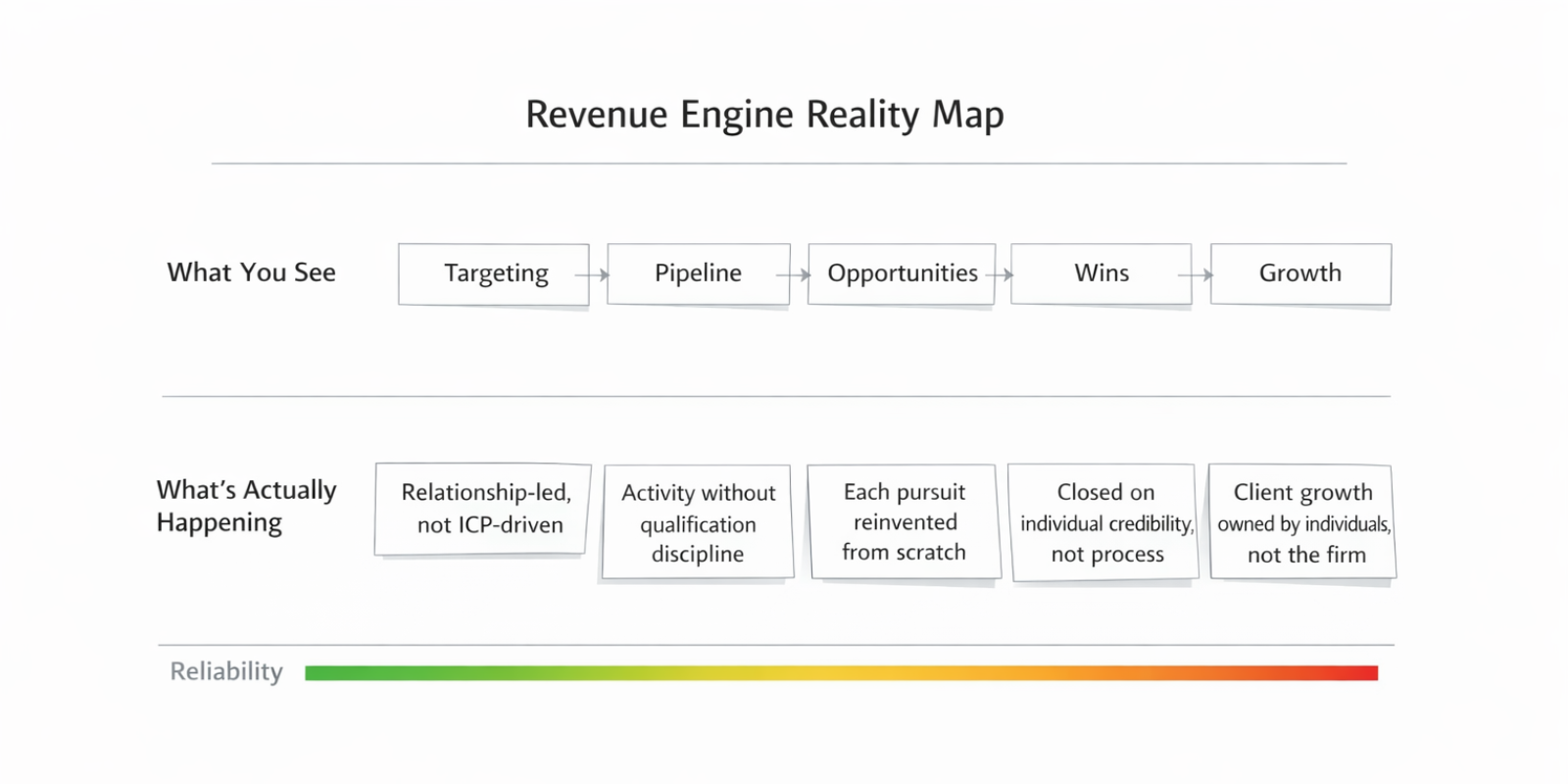
Many companies appear to have a functioning revenue engine. The pipeline is active. Opportunities are moving. Wins are happening.
But underneath that visible activity, results may still depend on a small number of people, inconsistent qualification, improvised pursuits, or client relationships the firm cannot really scale.
That creates risk—especially when leadership is making decisions about hiring, structure, investment, or acquisition based on the assumption that the engine is stronger than it is.
From the outside, the engine may look structured. Underneath, it may be much less reliable.
What the Visible System Can Hide
The issue is rarely a lack of growth effort. More often, the visible system and the actual system are not the same.
A company may appear to have a scalable engine while revenue still depends on:
relationship-led access rather than ICP discipline
activity without qualification rigor
pursuits rebuilt from scratch each time
wins driven by individual credibility
client growth owned by relationship holders rather than the firm
When those conditions persist, growth may continue for a time—but it becomes harder to predict, transfer, and scale.
What Actually Holds Up
A revenue engine does not become reliable because it has structure, tools, dashboards, or activity. It becomes scalable when a few conditions are consistently true:
You can explain where revenue comes from—without naming people
Access to meaningful opportunities is not controlled by a few individuals
Pursuits do not reset to zero every time
Wins are explainable and transferable
Clients belong to the firm, not only to the relationship owner
Activity and tooling do not masquerade as progress
If those conditions are not true, growth may still happen—but it is unlikely to hold up as competition increases, complexity grows, or leadership changes.
The Revenue Engine Reality Check
The Revenue Engine Reality Check is a focused, senior-level assessment designed to answer one question:
Does this organization have a revenue engine that will hold up as the business grows and competes—or are results still dependent on fragile execution, informal workarounds, or untested assumptions?
Over 30 days, I examine how revenue is actually generated, supported, and sustained, including:
targeting and ICP discipline
ownership of revenue decisions and accountability
which sales motions reliably convert and which consume effort
the role of marketing, referrals, thought leadership, and expansion
CRM, automation, and AI—what supports execution versus what adds friction
metrics that predict outcomes versus those that merely describe activity
What You Get
The output is a concise, board-ready Revenue Engine Risk & Leverage Map showing:
what is working and why
where results are fragile or inconsistent
what is likely to fail as volume or complexity increases
what should be fixed or stopped before committing additional time, hires or investment
This helps PE leaders and portfolio company teams make sharper decisions before adding headcount, restructuring go-to-market responsibilities, increasing spend, or assuming revenue synergies will materialize on their own.
When This Is Most Useful
This work is especially useful when:
growth feels less predictable than reporting suggests
leadership is debating additional hires, structure, or spend
recent changes have not led to consistent commercial traction
revenue depends too heavily on a few key individuals
commercial complexity is increasing faster than clarity
Why I Lead This Work
I’ve spent more than 30 years working with B2B and professional services companies where revenue depends on credibility, judgment, and execution—not volume marketing.
My background includes advising professional services and B2B firms at growth inflection points, business development and growth leadership work, and executive search and leadership assessment tied directly to commercial performance.
Get a Clear View of Your Revenue Engine
If you’re making growth decisions without full confidence in what’s actually driving results—or why you’re winning or losing the work you pursue—this is where to start.